4 Wochen4 WochenbookeBookeBookIn den Warenkorb16089-0151E16089APDF902Seiten2. aktualisierte und erweiterte Auflage 2026false16089Meine%20Empfehlung%3A%20ESG%20and%20Real%20EstateHallo%2C%20das%20folgende%20Produkt%20habe%20ich%20bei%20https%3A%2F%2Fshop.haufe.de%20entdeckt%3A%20%0AESG%20and%20Real%20Estate%0Ahttps%3A%2F%2Fshop.haufe.de%2Fprod%2Fesg-and-real-estate%2FE16089APDF%0A%0AMit%20freundlichen%20Gr%C3%BC%C3%9Fen%20%0A%0APS%3A%20Entdecken%20Sie%20weitere%20Neuheiten%20und%20interessante%20Produkte%20bei%20https%3A%2F%2Fshop.haufe.de.4 Wochen4 WochenbookBuchBuchVersandkostenfrei bestellen16089-0002E16089E16089978-3-648-18229-1902Seiten2. aktualisierte und erweiterte Auflage 2026Hardcoverfalse16089Meine%20Empfehlung%3A%20ESG%20and%20Real%20EstateHallo%2C%20das%20folgende%20Produkt%20habe%20ich%20bei%20https%3A%2F%2Fshop.haufe.de%20entdeckt%3A%20%0AESG%20and%20Real%20Estate%0Ahttps%3A%2F%2Fshop.haufe.de%2Fprod%2Fesg-and-real-estate%2FE16089%0A%0AMit%20freundlichen%20Gr%C3%BC%C3%9Fen%20%0A%0APS%3A%20Entdecken%20Sie%20weitere%20Neuheiten%20und%20interessante%20Produkte%20bei%20https%3A%2F%2Fshop.haufe.de.4 Wochen4 WochenbookeBookeBookIn den Warenkorb16089-0101E16089APUB902Seiten2. aktualisierte und erweiterte Auflage 2026false16089Meine%20Empfehlung%3A%20ESG%20and%20Real%20EstateHallo%2C%20das%20folgende%20Produkt%20habe%20ich%20bei%20https%3A%2F%2Fshop.haufe.de%20entdeckt%3A%20%0AESG%20and%20Real%20Estate%0Ahttps%3A%2F%2Fshop.haufe.de%2Fprod%2Fesg-and-real-estate%2FE16089APUB%0A%0AMit%20freundlichen%20Gr%C3%BC%C3%9Fen%20%0A%0APS%3A%20Entdecken%20Sie%20weitere%20Neuheiten%20und%20interessante%20Produkte%20bei%20https%3A%2F%2Fshop.haufe.de.https://media.static.esales.haufe.io/SEOShopData/media/pro/648/16089-0001-648.png/Haufe-esg-and-real-estate.jpg?id=8cb9d20184631f1e8088eea25d8b7d98a9d36b90
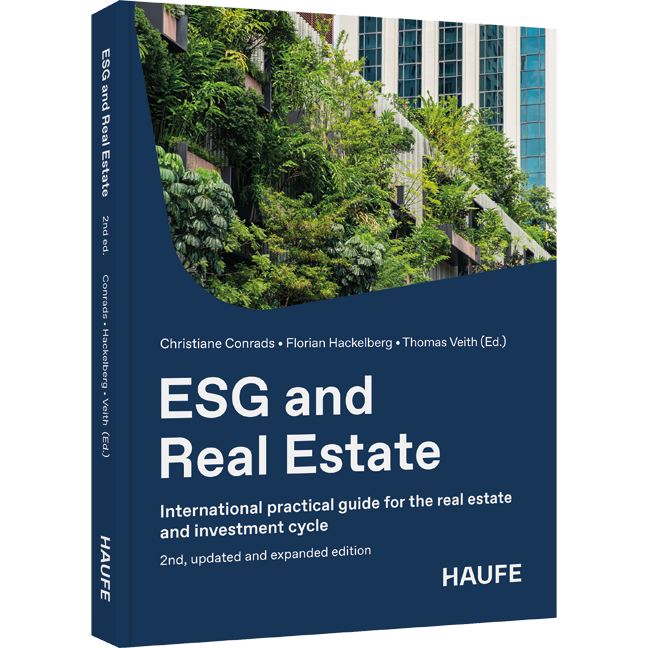
ESG has evolved into a structural control framework for investment decisions, business models, regulations, and risk management. This international handbook provides an in-depth and practical analysis of the ESG transformation within the real estate industry.
The second, completely revised edition illustrates how ESG has evolved from a guidance framework to an operational management tool. It has been expanded to include geographical perspectives and delves deeper into biodiversity, the circular economy, and sustainability reporting. Authors from leading international real estate companies, consultancies, and academic institutions shed light on ESG requirements in national and international contexts.
Contents:
A comprehensive guide to ESG and the real estate sector
ESG in a national and international context, including regional market chapters, international contributions, and local specifics of ESG strategies
ESG strategies and best practices for implementation in processes and systems
Expanded topics include climate protection, biodiversity, the circular economy, and sustainability reporting
Interdisciplinary perspectives include approaches from other industries, such as automotive and airports
ESG has evolved into a structural control framework for investment decisions, business models, regulations, and risk management. This international handbook provides an in-depth and practical analysis of the ESG transformation within the real estate industry.
The second, completely revised edition illustrates how ESG has evolved from a guidance framework to an operational management tool. It has been expanded to include geographical perspectives and delves deeper into biodiversity, the circular economy, and sustainability reporting. Authors from leading international real estate companies, consultancies, and academic institutions shed light on ESG requirements in national and international contexts.
Contents:
A comprehensive guide to ESG and the real estate sector
ESG in a national and international context, including regional market chapters, international contributions, and local specifics of ESG strategies
ESG strategies and best practices for implementation in processes and systems
Expanded topics include climate protection, biodiversity, the circular economy, and sustainability reporting
Interdisciplinary perspectives include approaches from other industries, such as automotive and airports
ESG has evolved into a structural control framework for investment decisions, business models, regulations, and risk management. This international handbook provides an in-depth and practical analysis of the ESG transformation within the real estate industry.
The second, completely revised edition illustrates how ESG has evolved from a guidance framework to an operational management tool. It has been expanded to include geographical perspectives and delves deeper into biodiversity, the circular economy, and sustainability reporting. Authors from leading international real estate companies, consultancies, and academic institutions shed light on ESG requirements in national and international contexts.
Contents:
A comprehensive guide to ESG and the real estate sector
ESG in a national and international context, including regional market chapters, international contributions, and local specifics of ESG strategies
ESG strategies and best practices for implementation in processes and systems
Expanded topics include climate protection, biodiversity, the circular economy, and sustainability reporting
Interdisciplinary perspectives include approaches from other industries, such as automotive and airports
International practical guide for the real estate and investment cycle
Important book on ESG and the real estate industry
Best practice examples as well as insights
Written by an interdisciplinary team of experts
Comprehensive practical handbook explaining current developments in the field of "Environmental Social Governance" and their impact on the real estate industry.
Megatrend sustainability in the real estate industry
ESG has evolved into a structural control framework for investment decisions, business models, regulations, and risk management. This international handbook provides an in-depth and practical analysis of the ESG transformation within the real estate industry.
The second, completely revised edition illustrates how ESG has evolved from a guidance framework to an operational management tool. It has been expanded to include geographical perspectives and delves deeper into biodiversity, the circular economy, and sustainability reporting. Authors from leading international real estate companies, consultancies, and academic institutions shed light on ESG requirements in national and international contexts.
Contents:
A comprehensive guide to ESG and the real estate sector
ESG in a national and international context, including regional market chapters, international contributions, and local specifics of ESG strategies
ESG strategies and best practices for implementation in processes and systems
Expanded topics include climate protection, biodiversity, the circular economy, and sustainability reporting
Interdisciplinary perspectives include approaches from other industries, such as automotive and airports
Vorteile
Aktuelles
ESG has evolved into a structural control framework for investment decisions, business models, regulations, and risk management. This international handbook provides an in-depth and practical analysis of the ESG transformation within the real estate industry.
The second, completely revised edition illustrates how ESG has evolved from a guidance framework to an operational management tool. It has been expanded to include geographical perspectives and delves deeper into biodiversity, the circular economy, and sustainability reporting. Authors from leading international real estate companies, consultancies, and academic institutions shed light on ESG requirements in national and international contexts.
Contents:
A comprehensive guide to ESG and the real estate sector
ESG in a national and international context, including regional market chapters, international contributions, and local specifics of ESG strategies
ESG strategies and best practices for implementation in processes and systems
Expanded topics include climate protection, biodiversity, the circular economy, and sustainability reporting
Interdisciplinary perspectives include approaches from other industries, such as automotive and airports
Vorteile
Aktuelles
ESG has evolved into a structural control framework for investment decisions, business models, regulations, and risk management. This international handbook provides an in-depth and practical analysis of the ESG transformation within the real estate industry.
The second, completely revised edition illustrates how ESG has evolved from a guidance framework to an operational management tool. It has been expanded to include geographical perspectives and delves deeper into biodiversity, the circular economy, and sustainability reporting. Authors from leading international real estate companies, consultancies, and academic institutions shed light on ESG requirements in national and international contexts.
Contents:
A comprehensive guide to ESG and the real estate sector
ESG in a national and international context, including regional market chapters, international contributions, and local specifics of ESG strategies
ESG strategies and best practices for implementation in processes and systems
Expanded topics include climate protection, biodiversity, the circular economy, and sustainability reporting
Interdisciplinary perspectives include approaches from other industries, such as automotive and airports
Christiane Conrads, LL.M., is a lawyer and PhD candidate at Leuphana University Lüneburg. Since 2012, she has advised on national and international market participants in the real estate industry on sustainability and ESG matters at the intersection of law, regulation and market implementation. Until the end of 2025, she was a partner in the Sustainability Services Platform at PwC Germany, where she led the Global Real Estate ESG Practice. In this role, she was responsible for the substantive and strategic steering of national and international ESG projects, with a particular focus on European ESG regulation, sustainable finance, governance, and the implementation of market-based requirements in the real estate industry. Today, her professional focus lies on the further development and sharpening of ESG approaches in the real estate sector. As part of her PhD research, she is examining the integration of biodiversity requirements into existing real estate assets and their legal, regulatory and practical implementation.
Florian Hackelberg
Prof. Dr. Florian Hackelberg is Professor of Real Estate Economics at the Berlin School of Economics and Law. Prior to this, he worked for many years in the Advisory Real Estate division at PwC in Berlin and Shanghai. After studying civil engineering and management in Germany, England and China, he obtained his doctorate from the Technical University of Berlin and completed a master's degree in International Relations at the University of Cambridge.
Thomas Veith
Thomas Veith is a partner at PwC in Frankfurt, leading the global Real Estate sector as well as Real Assets in Germany. He has over 30 years of experience in the real estate industry. After studying economics, he initially initiated real estate funds at a private bank before continuing his career at PwC.
Wir benötigen Ihre Zustimmung, um den Youtube-Service zu laden!
Wir verwenden einen Service eines Drittanbieters, um Videoinhalte einzubetten. Dieser Service kann Daten zu Ihren Aktivitäten sammeln. Bitte lesen Sie die Details durch und stimmen Sie der Nutzung des Service zu, um dieses Video anzusehen.